


In the Company of the Future episode of Raising An Agent, Quinn and I talked about what a typical week at Amp looks like:
I send out a message to the team on Sunday or early Monday morning. Not always, but when I think it’s needed or when I’m in the mood to write. There’s no strict formula, but these messages are often about what Quinn and I think are the most important things we should be thinking about.
On Monday morning we then have our team meeting. That’s the only scheduled meeting we have.
In that meeting we talk about what’s important, then we have silent writing time in which everyone writes down what they plan to ship this week. Then we go through that list.
Then we all work on what we talked about and constantly talk to each other in Amp or on Slack.
Justin Jackson decided to implement this at Transistor: message with important things, then meeting on Monday. And he seemed very happy about the outcomes!
So I thought I’d share a little bit about that Monday meeting (since it’s coming up tomorrow and already on my mind) because in the podcast we didn’t get into the details of it. But, disclaimer: it’s a very simple meeting, it’s not perfect, it’s slightly different each week (intentionally so!), and if you’ve ever been a part of one you might smile at the idea that there’s anything really worth talking about.
Here’s the top of the Monday meeting Google Doc right now:
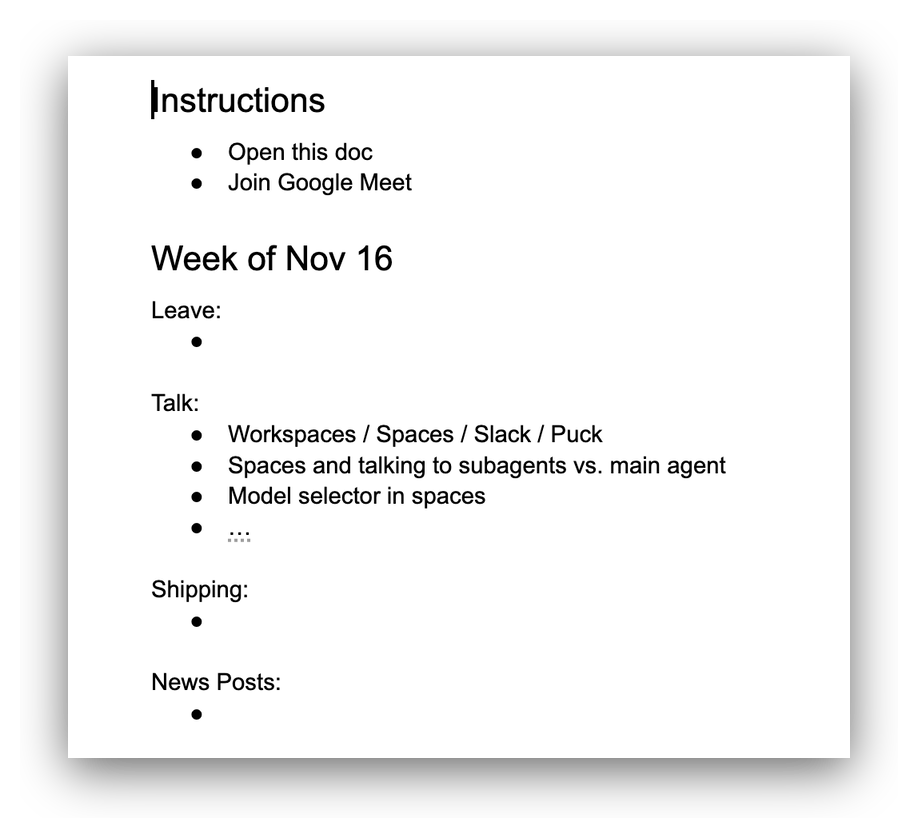
It’s important that everyone on the call has that document open and is fully focused on it. No other windows, not prompting the agent on the side. People should pay attention, listen to what others are saying, and build up peripheral vision of the whole team. It’s the only meeting in the week, it’s an hour. Everyone should be able to focus.
(Also: everybody should have their camera on!)
There are four sections to the meeting: Leave, Talk, Shipping, News Posts. And that already makes it sound fancier than it is.
Because what the whole thing boils down to is this: get everybody on the same page as to what’s important this week and together figure out how to achieve those goals or solve those problems. The rest is just there to help.
For the first five minutes of the meeting, we shoot the shit and just talk about whatever until everybody’s in the call.
Then we talk about Leave: who’s out this week, who’s out next week, who’s maybe out in 3 weeks. My rule of thumb: the longer you’re off, the earlier you should tell your team about it. If you’re off on Friday, it’s fine to share that on Monday. If you’re going to be off for two weeks in the jungle somewhere, you should probably share that two, three weeks in advance. Be an adult.
After that, we get to the main thing of the meeting, the Talk section. In the screenshot above, you can see that I’ve already put three topics in. These are the most important things I think we should talk about tomorrow. Everybody can add their own topics. While talking about things, we might add sub-bullet-points and notes and links and whatnot.
The Talk section takes up 45min or so. I try to be a good timekeeper and watch the clock so we can get to everything that’s in the doc. I probably say “any thoughts, questions, concerns, ideas?” ten times in that meeting, before moving on to the next section. I want everybody to participate.
The results of Talk are different each week: sometimes we find new things to do while talking and I might ask “who wants to own this?” Other times we conclude that we just need to keep doing what we’ve been doing that week. Or we call out 4-5 things that we need to ship ASAP and formulate a plan for that. Or we all think there’s a single most important thing that week and we try to figure out how we can all contribute.
It’s very loose. Anything goes really. Again, the goal is alignment and everybody being on the same page. The goal isn’t to follow The Process. Many roads lead to alignment.
After Talk and towards the end of the meeting, we get to Shipping and News Posts. For that, I set a timer on my phone, for 2-3 minutes, and we all write down in silence what we plan to ship this week. The goal is to be ambitious. Don’t write down things you check off a few hours later. We talked about the important things, now the question is: how are you planning to contribute based on that?
(Last year, when new people joined the Amp team, I often said: the first task on the Amp team is to figure out what your first task should be. I know it sounds silly, or rude, or like we’re throwing people into the deep end, and maybe we are, but it’s an incredible filter. There are tremendously good people who can show up and after 45min of talking go “how about I do …” Everybody on the Amp team is like that.)
When the timer rings, we go through the list top to bottom, and everybody says in 2-3 sentences what their goal for the week is, their focus areas. I might ask follow-up questions or suggest collaboration, or others might ask whether they can help, etc.
While we go through that, we try and make sure to note down any News Posts (see ampcode.com/chronicle) we need to write and ship that week. In other words: what are you planning to publicly release that week and when exactly? It’s important to at least get a rough sense of the timeline, so we don’t end up with 3 major features being shipped on the same day.
And… that’s it. Then everybody goes off and works on their thing.
But that doesn’t mean we won’t talk to each other again for a week. No, it’s the opposite. There will be lots of in-progress work being shared in #wip and others will ask and give feedback. There will be huddles and tagging of each other in Amp. There will be feedback in #orb-good and #orb-bad and plans will get adjusted based on that.
Could the meeting be better? Sure. But I do think we’ve hit on a sweet spot where we have just enough process for everybody to be aligned but little enough so it’s not a pain in the ass and we have freedom to adjust plans often.

And they say models can’t be creative: “I asked Fable 5.2 to ‘go wild’ making a game, and all I got was this Pong clone. And then I played it ...”
You have more influence over the future than you think: “The future will be fun. It will be exciting. You will soon be able to create any digital artifact imaginable within a couple of minutes. And many physical artifacts too, though that part is a bit more unclear to me.”
Linus on “keeping the flame”: “Counterintuitively, I’ve come to learn that keeping the flame alive is far more important to the integrity of our creative pursuits than actually producing the work itself. If we put something into the world that disappoints us, that’s okay. We can try again tomorrow, and the day after that, and after that, because the flame will still be there. But if we let the flame wither, by letting the firewoods run out or allowing others to blow it out, there is no tomorrow. There is no fight left in us. We have to start all over again, which may take months, or even years. How do we keep the flame alive?”
And since we’re talking about creativity… In case you’ve never seen this clip of Paul McCartney composing Get Back I highly recommend you do. It’s an impressive clip on its own, but in the context of the whole Get Back documentary it’s extraordinary. They sit there in this huge warehouse studio, they’re bored, they’re waiting a lot, and not much is going on; they’re drinking tea and talk; there’s a crew standing around looking at them at all times. And then McCartney feels like he has to push things forward and do something and he sits down and George and Ringo are yawning and it’s what I imagine to be the least inspiring atmosphere and yet McCartney starts riffing and that song emerges…. It’s very easy and comforting to think that creativity is something that happens or doesn’t and that you can’t do anything about it. And, hey, that’s true, the phrase “some things you can’t force” isn’t just a cliché. But sometimes, man, I think sometimes you just have to put your head down and see if you can’t make creativity happen.
I’m really not a big space guy (don’t know why, honestly; rockets & space are cool but don’t excite me that much), but this was one hell of a video: “Mechazilla catches Starship! Congratulations to the entire SpaceX team on this incredible achievement!” The music! Is that Steely Dan? Who puts such chill music on for this moment? And then it cuts out and you go “holy shit” and then the music comes back and you wonder whether you just watched a little recap scene from a movie filmed in 2053.
Paul Ford: The Web Is More Than Enough. Hell yes! I love the web. I stored the link to this post in a little web app that I built on my phone. A native app would be nice, but man, the web is so much better. I can run an agent on the box on which the web app is running, I can deploy ten trillion times a day, I can get easy debug logs, … The web is awesome.
This is very, very, very, very, very good: Writing as a thinking tool. So many things to quote here — the part about writing in the age of LLMs, the “Mess up” rule, the thought about externalized thinking — so go and read it and then write something.
Michael Crichton, psychology, and AI. In the last two years, we’ve all heard many “… but only a human can do this” claims only for them to look silly a couple months later. So now, whenever something just starts to sound like it’s a similar claim, my eyebrows go up. But this one is different. At least I think it is? Interesting stuff.
New Ways to Read Ebooks. I’m very much not a “I need to own all my ebooks as files on my disk” kinda guy. I love my Kindle and, hey, maybe love is too strong a word, but I like Amazon. But by now it’s just frustrating that I can’t give my agent access to my Kindle library and help me find quotes and answers. I’d even buy more books just so I can feed them to my agent, not to read them for me, but to help me refind and extract things. That’s all I could think about while reading this post. And that I have to get Amp to hack my Xteink X4.
CHIMERA. I don’t even know what to say here. It has taken over my brain. All day long I think of this voice. Click that link, watch that video. You must. And then watch these: one, two, three, four, five, six, seven, eight, nine, ten, eleven, and mine. After that, your brain has been taken over too. The next step is to then fork CHIMERA and point your agent at it and go crazy. And then lean back and think about what’s going on. Think: if I had to make a computer emit sound like a human voice, how would I do it? And after you’ve thought about that for a while, remember what CHIMERA does: “my vocal synth models the vocal tract as a network of branching acoustic tubes.” And then open it up again and think “this is fucking crazy.”
If you ever feel sad, watch this video. Works every time.
What a job! “You don’t have to tell me what day it is.” There are just very few things better than watching someone be exceptional at what they do.
